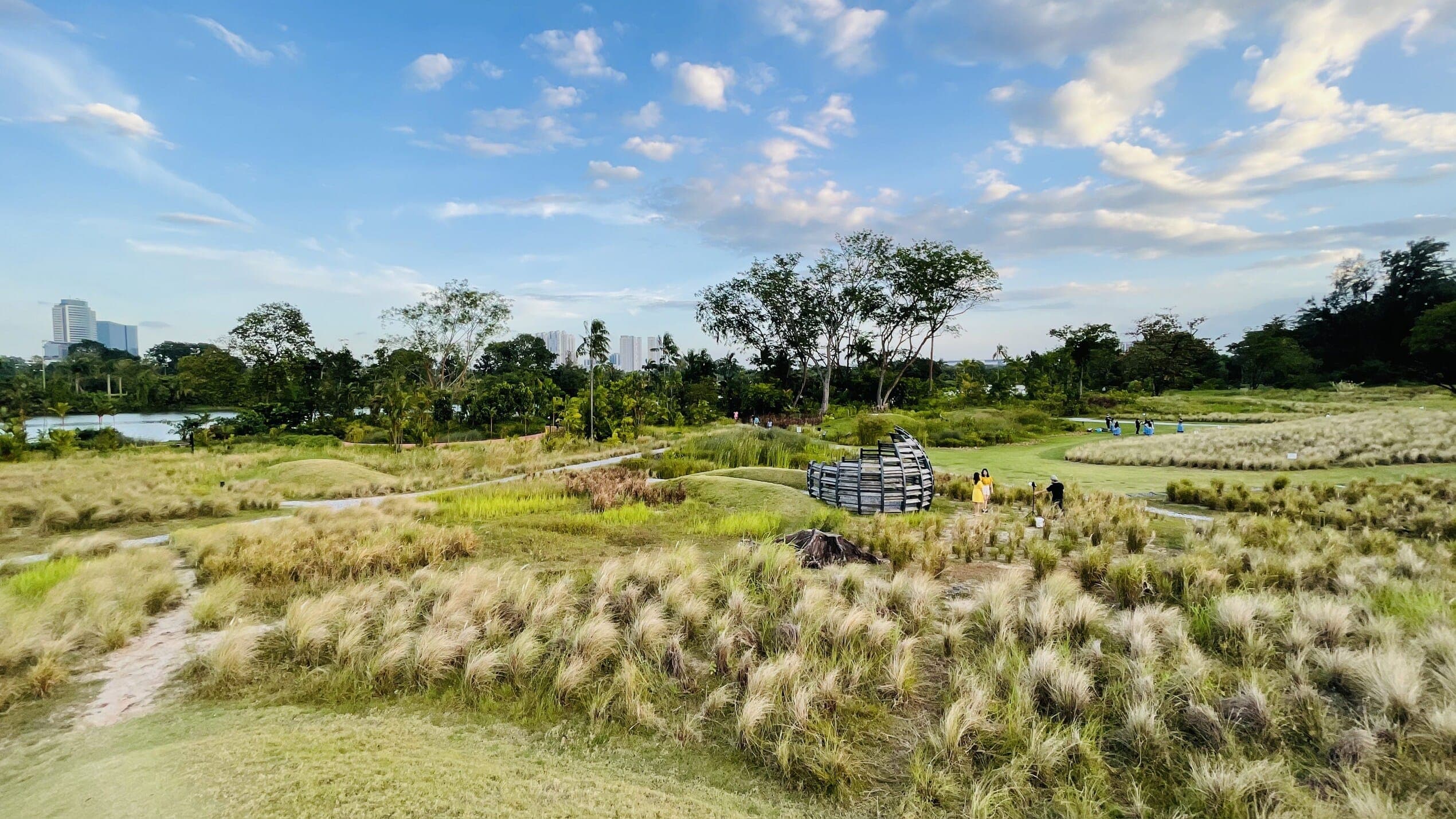
Building urban resilience through natural infrastructure
We, at the Resilient and Inclusive Cities Lab, provide evidence on the role of natural infrastructure for urban resilience and climate adaptation in Asia-Pacific.
About RICL
Our world has become urban. While this opens up opportunities, it also exacerbates some environmental and social challenges such as flooding, urban heat island, or mental and physical health issues. Conserving and creating natural infrastructure–parks, trees, green roofs, urban forests–can respond to these challenges by leveraging important natural benefits such as retaining water, cooling the air, providing opportunities for recreation, and supporting climate solutions.
The Resilient and Inclusive Cities Lab at Nanyang Technological University's Asian School of the Environment aims to increase the evidence base on the role of natural infrastructure for urban resilience and climate adaptation in Asia-Pacific and inform policy and practice to create more resilient and inclusive cities. The research is supported by the Singapore National Research Foundation (NRFF12-2020-0009).


Research rooted in place Evidence from across the Asia-Pacific, gathered with local partners.


Perrine Hamel is an Associate Professor at Nanyang Technological University (NTU)’s Asian School of the Environment. Her research and teaching focus on nature-based solutions, ecosystem-based management, and water resource management.
Prior to joining NTU, she was a senior scientist with the Natural Capital Project at Stanford University, where she conducted ecosystem services assessments and developed decision-support tools. She is also the co-founder of Pulse, an AI-powered software as a service (SaaS) platform designed to make nature-positive engagement accessible, actionable, and regionally grounded for businesses in Southeast Asia.
She graduated with a Master in Civil and Environmental Engineering from Ecole Centrale Nantes, France, and a PhD from Monash University, Australia, and has previously worked as an environmental engineer in Phnom Penh, Cambodia.
Featured Topics
Jakarta Flood Resilience
Community-led flood adaptation in Jakarta's informal settlements, pairing hydrological modelling with local planning.
Country Indonesia
Singapore Cooling Corridors
Mapping and greening urban heat corridors in Singapore to lower temperatures and improve liveability.
Country Singapore
Mekong Delta ES Modelling
InVEST-based ecosystem-services modelling for the Mekong Delta, informing nature-based development scenarios.
Country Vietnam
 View All
Funding Partners
Our research is made possible by the foundations, research councils, and agencies that fund work on natural infrastructure and urban resilience across the Asia-Pacific.

Supporting Institutions
We work alongside universities, research institutes, and government partners across the region, grounding the lab's evidence in local knowledge and the needs of policy and practice.